Monday, October 15, 2012
The Lexington Stars - the Might Town Royalty new Category A online in the Southern Ocean Group - lately revealed a product new shade plan, consistent style and logo to match with their organization modify. And when we say product new, we mean it, because Lexington will become the first minor-league football group to put on lotion, elegant red and kelly felix natural shade blends. That is exclusive to say the least.
Oh, and we should also discuss they'll become the first group to function a mustache logo all by itself on one of their three new hat styles, because let's be sincere, who wouldn't want to own or use a hat noticeably presenting a mustache
They definitely prevailed in providing on the wow aspect, because again, their additional pet mascot logo design is a mustache. But that aspect aside, they also provided during the huge introduction wedding by having their pet and inspiration for the new logo, the mustachioed Big L, rappel 410 legs down the side of the Lexington Financial Middle while dressed in the new styles.
As for the Legends' main logo in 2013, gm Seth Poteat says that will still function a scowling Big L with football softball bats traversing behind his go, so they haven't strayed too far away from their identification. But at first they weren't even sure if they desired to upgrade or modify the logo at all as a aspect of the style up-dates.
Saturday, August 11, 2012
The Pleven Regional Historical Museum has its roots in the local Archaeological Society founded in 1903, the goals of which included the creation of a museum, as well as the discovery and investigate of historical monuments in the town and the area. The first excavations of the Roman fortress of Storgosia in Kaylaka Park in May 1905 were organized and carried out by the society under the direction of Yurdan Kantardzhiev.

A museum collection that exhibited the items found was assembled by the society in 1911. In 1923, all the materials were moved to the Saglasie Community Centre, where a museum was established.
Officially founded in 1953, the museum moved to its current construction, built between 1884 and 1888 after an Italian project for barracks, in 1984.
The museum became regional on 1 July 2000, embracing the provinces of Pleven and Lovech.
A museum collection that exhibited the items found was assembled by the society in 1911. In 1923, all the materials were moved to the Saglasie Community Centre, where a museum was established.
Officially founded in 1953, the museum moved to its current construction, built between 1884 and 1888 after an Italian project for barracks, in 1984.
The museum became regional on 1 July 2000, embracing the provinces of Pleven and Lovech.
Friday, June 15, 2012

Artemisia Gentileschi was an Italian Baroque painter, nowadays considered one of the most accomplished painters in the generation after Caravaggio. In an era when women painters were not easily accepted by the artistic community or patrons, she was the first female painter to become a member of the Accademia di Arte del Disegno in Florence.
She painted numerous pictures of strong and suffering women from myth and the Bible – victims, suicides, warriors – and made a speciality of the Judith story. Her best-known image, Judith Beheading Holofernes shows the decapitation of Holofernes, a scene of terrible struggle and blood-letting. That she was a woman painting in the 17th century and that she was raped herself and participated in prosecuting the rapist long overshadowed her achievements as an artist. For many years she was regarded as a curiosity. Today she is regarded as one of the most progressive and expressionist painters of her generation.
In Florence, Artemisia enjoyed enormous success. She was the first woman accepted into the Accademia delle Arti del Disegno. She maintained good relations with the most respected artists of her time, such as Cristofano Allori, and was able to garner the favours and the protection of influential people, starting with Granduke Cosimo II de' Medici and especially of the Granduchess Cristina.
She had a good relationship with Galileo Galilei with whom she remained in epistolary contact for a long time. She was esteemed by Michelangelo Buonarroti the younger busy with construction of Casa Buonarroti to celebrate his notable relative, he asked Artemisia to produce a painting to decorate the ceiling of the gallery of paintings.
The first author who produced a novel around the figure of Artemisia was Anna Banti, wife of Roberto Longhi. Her first draft of the manuscript, dated 1944, was lost throughout the war. Three years later she started again with the book, to be called Artemisia, writing in a much different form. Banti's book is written in an "open diary" form, in which she maintains a dialogue with Artemisia, trying to understand why she finds her so fascinating.
More than 50 years later, in 1999, the French writer Alexandra Lapierre became fascinated by Artemisia and wrote a novel about her, derived from scrupulous study of the painter and the historical context of her work.
Friday, April 20, 2012

The Marble also identified as the Boat of Purity and Ease is a lakeside pavilion on the grounds of the Summer Palace in Beijing, China.
It was first erected in 1755 throughout the reign of the Qianlong Emperor. The original pavilion was made from a base of huge stone blocks which supported a wooden superstructure done in a traditional Chinese design.
In 1860, throughout the Second Opium War, the pavilion was destroyed by Anglo-French forces. It was restored in 1893 on order of the Empress Dowager Cixi. In this restoration, a new two-story superstructure was designed which incorporated elements of European architecture.
Like its predecessor, the new superstructure is made out of wood but it was absolutely painted to imitate marble. On each "deck", there is a large mirror to reflect the waters of the lake and give an impression of total immersion in the aquatic surroundings. Imitation paddlewheels on every side of the pavilion makes it look like a paddle steamer. The pavilion has a sophisticated drainage system which channels rain water through four hollow pillars. The water is lastly released into the lake through the mouths of four dragonheads.
The boat design of the pavilion can relate to a quote attributed to Wei Zheng, a chancellor of the Tang Dynasty renowned for his honest advice. He is said to have told the emperor "the waters that float the boat can also swallow it", implying that the people will support the emperor but can also topple him. With this in mind, Emperor Qianlong might have chosen to construct the Marble Boat on a solid stone base to point out that the Qing Dynasty was not to be overthrown.
The Marble Boat is often seen as an ironic commentary on the actual fact that the money used to restore the Summer Palace largely came from funds originally earmarked for building up a new imperial navy. The controller of the Admiralty, Prince Chun, owed much of his social standing as well as his appointment to the Empress Dowager, who had adopted his oldest son to become the Guangxu Emperor. Because of this, he probably saw no other alternative than to condone the embezzlement.
The pavilion is 36 meters long. It stands on the northwestern shore of Kunming Lake, near the western end of the Long Corridor.
Tuesday, April 10, 2012

Naum Gabo KBE, born Naum Neemia Pevsner (5 August [24 July] 1890 – 23 August 1977) was a famous Russian sculptor in the Constructivism movement and a pioneer of Kinetic Art. Gabo grew up in a Jewish family of six children in the provincial Russian town of Bryansk, where his father owned a factory.
His older brother was fellow Constructivist artist Antoine Pevsner; Gabo modified his name to avoid misunderstanding with him. Gabo was a fluent speaker and writer of German, French, and English in addition to his native Russian. His command of many languages contributed greatly to his mobility during his career. “As in thought, so in feeling, a vague communication is not any communication at all," Gabo once remarked.
Gabo’s Theory of Art:
The essence of Gabo's art was the exploration of space which he believed may be done without having to depict mass. His earliest constructions such as Head No.2 were formal experiments in depicting the volume of a figure without carrying its mass. Gabo's other concern as described in the Realist Manifesto was that art required to exist actively in four dimensions including time.
Gabo's childhood years were in Munich, where he was impressed by and actively participated in the artistic, scientific, and philosophical debates of the early years of the 20th century. Because of his involvement in these intellectual debates, Gabo became a number one figure in Moscow’s avant garde, in post-Revolution Russia.
It was in Munich that Gabo attended the lectures of art historian Heinrich Wolff in and gained information of the ideas of Einstein and his fellow innovators of scientific theory, also the philosopher Henri Bergson.
As a student of medicine, natural science and engineering, his understanding of the order present in the natural world mystically links all creation in the universe. Just before the onset of the First World War in 1914, Gabo discovered fashionable art, by reading Kandinsky’s Concerning the Spiritual in Art, which asserted the principles of abstract art.
Friday, March 30, 2012

The Cathedral of the Annunciation is a Russian traditional Church dedicated to the Annunciation of the Theotokos. It is located on the southwest side of Cathedral Square of the Moscow Kremlin in Russia, where it connects directly to the main building of the difficult of the Grand Kremlin Palace, adjacent to the Palace of Facets. It was originally the personal chapel for the Muscovite tsars, and its abbot remained a individual confessor of the Russian royal family until the early 20th century.
The Cathedral of the Annunciation was built by architects from Pskov in 1484-1489 as part of Grand Duke Ivan III plans for a large-scale redecoration of the Moscow Kremlin. It was built on the spot of an older 14th century cathedral of the same name, which had been reconstruction in 1416. This older cathedral in turn had replaced a previous wooden church from the 13th century that had fallen victim to the regular fires in the Kremlin.
Compared with the other two major Kremlin cathedrals, the Annunciation Cathedral has slightly smaller dimensions. It is also built in a more traditional style, as it was created by local architects from Pskov, rather than Italian emigrant architects. The most characteristic feature of the building is its nine beautiful golden domes, and roof with rich kokoshnik ornamentation in an ogive form.
The Cathedral was built of brick, with facades of white limestone that are decent and decorated. There are entrances to the cathedral on the eastern and also the southern side of the building, with fretwork influenced by Italian Renaissance architecture.
The bronze doors are decorated with gold foil. Tourists enter the cathedral via the eastern staircase, while the southern staircase is that the one added in 1570 by Ivan the Terrible. The relatively high entrance is due to the very fact that the building was built on the raised base of its predecessor.
The interior of the cathedral consists of the central prayer area and several surrounding galleries, with the additions of side altars in the 16th Century. The northern is the first gallery space, which is entered through the visitor entrance.
Wednesday, March 21, 2012

Hashim ud-Daula, Nawab Ja'afar Ali Khan Bahadur, Mahabat Jang commonly known as Mir Jafar, second son of Sayyid Ahmad Najafi, (1691–February 5, 1765) was Nawab of Bengal, Bihar and Orissa. He is also known by Indians as Gaddar-e-Abrar. He succeeded Siraj-Ud-Daulah as the eighth Nawab of Bengal, and the first of the Najafi dynasty after misleading Nawab Siraj-Ud-Daulah and surrendering his army in battle field against Robert Clive.
His rule is extensively considered the start of British rule in India and was a key step in eventual British domination of the country. His greed of becoming Nawab of Bengal, led him to make a secret deal with Robert Clive and surrender & slaughter of Army of Bengal in Battle of Plessey, without fighting, which led to foundation of British rule in India. For this act of treachery, he has been infamously called Gaddar-e-Abrar. Gaddar means a traitor & Abrar means faith.
However, Mir Jafar had higher ambitions. Arrogant in his position he took advantage of an Ali Vardi Khan weakened by a decade of fighting with Marathas to enter into a conspiracy with Ataullah to overthrow and murder the Nawab. However, the conspiracy was unearthed and he was stripped of most of his powers. He came back to Murshidabad, where he regained the trust of the Nawab's grandson, Siraj-Ud-Daulah, and slowly returned to power and prominence.
After Siraj Ud Daulah’s defeat and subsequent execution, Mir Jafar achieved his long-pursued dream of gaining the throne, and was propped up by the British as puppet Nawab. Mir Jafar paid a sum of Rs. 17,700,000 as compensation for the attack on Calcutta to the company and the traders of the city. In addition, he paid large sums as gifts or bribes to the officials of the company.
Clive, for example received over two million rupees, Watts over one million Soon, however, he realized that British expectations were boundless and tried to move about out from under them; this time with the help of the Dutch.
However, the British defeated the Dutch at the Battle of Chinsurah in November 1759 and retaliated by forcing him to abdicate in favor of his son-in-law Mir Qasim. However, Mir Qasim proved to be able and independent, eager to live with but not bow to the British. The Company soon went to war with him, and he was eventually overthrown. Mir Jafar managed to regain the good graces of the British; he was again appointed Nawab in 1763 and held the position until his death in 1765.
Thursday, March 15, 2012

The Palace of the Facets may be a building in the Moscow Kremlin, Russia, which contains what used to be the main banquet reception hall of the Muscovite Tsars. It is the oldest preserved secular building in Moscow. Located on Kremlin Cathedral Square, between the Cathedral of the Annunciation and the Dormition Cathedral. Currently, it is an official ceremonial hall in the residence of the President of the Russian Federation and thus closed to the public. Only its eastern facade facing toward Cathedral Square can be viewed.
About Facets Building:
Named when its distinctive stonework eastern facade with horizontal rows of sharp-edged stones, the Palace of sides is all that is left of a larger royal palace made of white limestone. Although from the facade, it seems to be a three-story rectangular building from the outside, it is actually a one-story building with a semi-basement. On the west side the building is directly linked to the central building of the Grand Kremlin Palace.
The first floor of the Palace of the Facets consists of the main hall and adjoining sacred vestibule. Both are decorated with wealthy frescoes and gilded carvings. The splendid vaulted main hall has an area of about 500 m² (5,380 ft²). The whole vault and the walls are frescoed with elaborate several themes from the history of the Russian State and the Russian Orthodox Church.

This was used as a throne room and banqueting hall for the 16th-century and 17th-century tsars and is continues to be used for holding formal state receptions. The paintings are restored in the 1880s by icon painters from Palekh by order of Tsar Alexander III.
On the palace's southern facade is that the Red Porch, an external staircase decorated with stylized lion sculptures on the railings. The tsars passed down this staircase on their way to the Cathedral of the Dormition for his or her coronations. The last such procession was at the coronation of Nicholas II in 1896.
In the Streltsy Uprising in 1682 many of Tsar Peter the Great's rebellious relatives were hurled down the staircase onto the pikes of the Streltsy guard. Demolished by Joseph Stalin in the 1930s and replaced with a canteen for Kremlin workers, the staircase was rebuilt in 1994 at great expense.
Tuesday, January 31, 2012

Francis Danby (16 November 1793 – 9 February 1861) was an Irish painter of the Romantic era. His imaginative, dramatic landscapes were comparable to those of John Martin. Danby initially developed his creative style while he was the central figure in a group of artists who have come to be known as the Bristol School. His period of greatest success was in London in the 1820s.
Early life:
Born in the south of Ireland, he was one of a set of twins; his father, James Danby, farmed small assets he owned near Wexford, but his death, in 1807, caused the family to move to Dublin, while Francis was still a schoolboy. He began to practice drawing at the Royal Dublin Society's schools; and under an erratic young artist named James Arthur O'Connor he began painting landscapes. Danby also made acquaintance with George Petrie.
In 1813 Danby left for London together with O'Connor and Petrie.This journey, undertaken with very inadequate funds, quickly came to an end, and they had to get home again by walking. At Bristol they made a pause, and Danby, finding he could get trifling sums for water-color drawings, remained there working diligently and sending to the London exhibitions pictures of importance. There his large oil paintings quickly attracted attention.
Latest Years:
Danby exhibited his large (15 feet wide) and powerful The Deluge that year; the success of that painting, "the largest and most dramatic of all his Martinique visions," revitalized his reputation and career. Other pictures by him were The Golden Age (c. 1827, exhibited 1831), Rich and Rare Were the Gems She Wore (1837), and The Evening Gun (1848).
Some of Danby's later paintings, like The Wood nymph’s Hymn to the Rising Sun (1845), tended toward a calmer, more restrained, more cheerful manner than those in his earlier style; but he returned to his early mode for The Shipwreck (1859). He lived his final years at Exmouth in Devon, where he died in 1861. Along with John Martin and J. M. W. Turner, Danby is considered among the leading British artists of the Romantic period.
Thursday, January 12, 2012

Vele's is also called Volos, is a major Slavic supernatural force of earth, waters and the underworld associated with dragons, cattle, magic etc. He is one of the opponents of the Supreme thunder god Perun, and battle between two of them constitutes one of the most important myths of Slavic Mythology.
No direct accounts survive, but reconstructions speculate that he may directly continue aspects of the Proto-Indo-European pantheon and that he might have been imagined as serpentine, with horns and a long beard.Vels is one of few Slavic gods for which evidence of offerings will be found in all Slavic nations.
Volos is mentioned as god of cattle and pleasants, who will punish oath-breakers with diseases, the opposite of Perun who is described as a decision god of war who punishes by death in battle.
In the latter half of 10th century, Volos was one of seven gods whose statues Vladimir I, Prince of Kiev had erected in his city. It is very interesting that vele’s statue it seems that did not stand next others, but it also shows that worship of perun and veles had to be kept separate, while it was proper for Perun's shrines to be built high, on the top of the hill, Vele’s place was down, in the lowlands.

The reason of enmity between the two god’s is Vele’s theft of Perun's son, wife or, usually, cattle. It is also an act of challenge: Vele’s, in the form of an enormous serpent, slithers from the caves of the Underworld and coils upwards the Slavic world tree towards Perun's heavenly domain.
Perun retaliates and attacks Vele’s with his lightning bolts. Vele’s flees hiding or transforming himself into trees, animals or people. In the end he is killed by Perun, and in this ritual death, whatever Vele’s stole is released from his battered body in form of rain falling from the skies.
This Storm myth, as it is usually referred to by scholars today, explained to ancient Slavs the changing of seasons through the year. The dry periods were interpreted as chaotic results of Vele’s thievery. Storms and lightning were seen as divine battles. The following rain was the victory of Perun over Vele’s and re-establishment of world order.
Wednesday, January 4, 2012
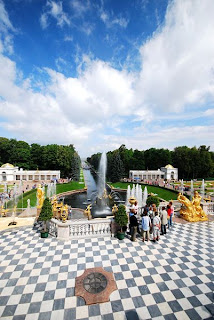
The Peterhof Palace is actually a series of palaces and gardens located in Saint Petersburg, Russia laid out on the orders of Peter the Great. The most dominant natural feature of Peterhof is a sixteen-meter-high bluff lying less than a hundred meters from the shore.
The majority of Peterhof's fountains are contained here, as are several small palaces and outbuildings. East of the Lower Gardens lies the Alexandria Park with 19th-century Gothic Revival structures such as the Kapella.
The Grand Cascade is modeled on one constructed for Louis XIV at his Château de Marly, which is likewise memorialized in one of the park's outbuildings.
At the centre of the cascade is an artificial grotto with two stories, faced inside and out with hewn brown stone. It currently contains a modest museum of the fountains' history. One of the exhibits is a table carrying a bowl of (artificial) fruit, a replica of a similar table built under Peter's direction. The table is rigged with jets of water that soak visitors when they reach for the fruit, a feature from Mannerist gardens that remained popular in Germany. The grotto is connected to the palace above and behind by a hidden corridor.
The fountains of the Grand Cascade are located below the grotto and on either side of it. Their waters flow into a semicircular pool, the terminus of the fountain-lined Sea Channel. In the 1730s, the large Samson Fountain was placed in this pool.
It depicts the moment when Samson tears open the jaws of a lion, representing Russia's victory over Sweden in the Great Northern War, and is doubly symbolic. The lion is an element of the Swedish coat of arms, and one of the great victories of the war was won on St Samson's Day.
From the lion's mouth shoots a 20-metre-high vertical jet of water, the highest in all of Peterhof. This masterpiece by Mikhail Kozlovsky was looted by the invading Germans during the Second World War; see History below. A replica of the statue was installed in 1947.
Wednesday, December 28, 2011

The history of Budapest began with Aquincum, originally a Celtic settlement that became the Roman capital of Lower Pannonia. Hungarians arrived in the territory in the 9th century. Their first settlement was pillaged by the Mongols in 1241-42. The re-established town became one of the centers of Renaissance humanist culture in the 15th century. Following the Battle of Mohacs and nearly 150 years of Ottoman rule, development of the region entered a fresh age of prosperity in the 18th and 19th centuries, and Budapest became a global city after the 1873 unification.
It also became the second capital of Austria-Hungary, an excellent power that dissolved in 1918. Budapest was the focal point of the Hungarian Revolution of 1848, the Hungarian Soviet Republic of 1919, Operation Panzerfaust in 1944, the Battle of Budapest of 1945, and also the Revolution of 1956.
The first settlement on the territory of Budapest was built by Celts before 1 AD. It was later occupied by the Romans. The Roman settlement - Aquincum - became the main city of Lower Pannonia in 106 AD. The Romans constructed roads, amphitheaters, baths and houses with heated floors during this fortified military camp.
The peace treaty of 829 added Pannonia to Bulgaria due to the victory of Bulgarian army of Omurtag over Holy Roman Empire of Louis the Pious. Budapest arose out of two Bulgarian military frontier fortresses Buda and Pest, situated on the two banks of Danube. Hungarians led by Arpad settled in the territory at the end of the 9th century, and a century later officially founded the Kingdom of Hungary. Research places the probable residence of the Arpads as an early place of central power close to what became Budapest.
The Tatar invasion in the 13th century quickly proved that defence is difficult on a plain. King Bella IV of Hungary thus ordered the construction of reinforced stone walls around the towns and set his own royal palace on the top of the protecting hills of Buda. In 1361 it became the capital of Hungary.
The cultural role of Buda was particularly significant throughout the reign of Matthias Corvinus of Hungary. The Italian Renaissance had an excellent influence on the city. His library, the Bibliotheca Corviniana, was Europe's greatest collection of historical chronicles and philosophic and scientific works in the 15th century, and second only in size to the Vatican Library.
After the foundation of the first Hungarian university in Pecs in 1367, the second one was established in Obuda in 1395. The first Hungarian book was printed in Buda in 1473. Buda had about 5,000 inhabitants around 1500
Thursday, December 15, 2011

"The Princess and the Pea" may be a literary fairy tale by Hans Christian Andersen about a young woman whose royal identity is established by a test of her physical sensitivity. The story was first published with three others by Andersen in an inexpensive booklet on 8 May 1835 in Copenhagen by C.A. Reitzel.
Andersen had heard the story as a child, and it likely has its source in folk material, possibly originating from Sweden as it is unknown within the Danish oral tradition. Neither “The Princess nor the Pea" nor Andersen's other story of 1835 were well received by Danish critics, who disliked their casual, chatty style, and their lack of morals.
In 1959 "The Princess and therefore the Pea" was adapted to the musical stage in a production referred to as once upon a Mattress starring Carol Burnett.
Plot:
The story tells of a prince who desires to marry a princess, but is having difficulty finding a suitable wife. Something is always wrong with those he meets, and he cannot be certain they are real princesses. One stormy night, a young woman drenched with rain seeks shelter in the prince's castle.

She claims to be a princess, so the prince's mother decides to test their unexpected guest by placing a pea in the bed she is offered for the night, covered by 20 mattresses and 20 feather beds. In the morning the guest tells her hosts—in a speech colored with double entendres —that she endured a sleepless night, kept awake by something hard in the bed; which she is certain has bruised her.
The prince rejoices. Only a real princess would have the sensitivity to feel a pea through such a quantity of bedding. The two are married, and the pea is placed in the Royal Museum.
Sunday, December 11, 2011

Sadko may be a Russian medieval epic. The title character is an adventurer, merchant and gusli musician from Novgorod. Sadko played the gusli on the shores of a lake.

Motifs:
The Sea Tsar enjoyed his music, and offered to help him. Sadko was instructed to create a bet with the local merchants regarding catching a certain fish in the lake; when he caught it, the merchants had to pay the wager, making Sadko a rich merchant.
Sadko traded on the seas along with his new wealth, but did not pay proper respects to the Tsar as per their agreement. The Tsar stopped Sadko's ships in the sea.
He and his sailors tried to appease the Sea Tsar with gold, to no avail. Sadko's crew forced him to jump into the ocean. There, he played the gusli for the Sea Tsar, who offered him a new bride. On advice, he took the last maiden during a long line, and lay down beside her.
He woke up on the seashore and rejoined his wife.
Motifs:
In some variants, Sadko is chosen to jump overboard by throwing lots between the men. This motif may be a widespread device, appearing, for instance, in Child ballad 57 Brown Robyn's Confession.
Adaptations:
This tale attracted the attention of many authors in the 19th century with the rise of the Slavophile movement and served as a basis for a variety of derived works, most notably the poem "Sadko" by Alexei Tolstoy (1871–1872) and the opera Sadko composed by Nikolai Rimsky-Korsakov, who also wrote the libretto. In 1953, Aleksandr Ptushko directed a movie based on the opera entitled Sadko. A shortened and heavily-modified American version of this film entitled The Magic Voyage of Sinbad was spoofed on Mystery Science Theater 3000.
Historical parallels:
Sadko will be viewed as a metaphor for Yaroslavl the Wise. The liberation of the Novgorodian people by Sadko may be linked to the establishment of the Novgorod Republic by Yaroslavl. Sadko might also be based on an exact Sedko Sitinits, who is mentioned in the Novgorodian First Chronicle as the patron of the stone Church of Boris and Gleb built in the Novgorodian Detinets in 116.
Tuesday, November 29, 2011

I and the Village may be a 1911 painting by the Russian-French artist Marc Chagall. It is currently exhibited at the Museum of Modern Art, New York.
The work contains several soft, dreamlike images overlapping each other in a continuous space: within the foreground, a cap-wearing green-faced man stares at a goat or sheep with the image of a smaller goat being milked on its cheek. In the foreground maybe a glowing tree held in the man's dark hand.
The background features a collection of houses next to an Orthodox church, and an upside-down female violinist in front of a black-clothed man holding a scythe. Note that the green-faced man wears a necklace with St. Andrew's cross, indicating that the man is a Christian. As the title suggests, I and the Village is influenced by memories of the artist's place of birth and his relationship to it.
The significance of the painting lies in its seamless integration of various elements of Eastern European folktales and culture, both Russian and Yiddish. Its clearly defined semiotic elements and daringly whimsical style were at the time considered groundbreaking. Its frenetic, fanciful style is credited to Chagall's childhood memories becoming, in the words of scholar H.W. Janson, a "cubist fairy tale" reshaped by his imagination, without regard to natural color, size or even the laws of gravity.
Thursday, November 24, 2011

Sandstone is a sedimentary rock composed mainly of sand-sized minerals or rock grains.

Some sandstone are resistant to weathering, yet are easy to work. This makes sandstone a common building a paving material. However, some that have been used in the past, such as the Collyhurst sandstone used in North West England, have been found less resistant, necessitating repair and replacement in older buildings.
Most sandstone is consists of quartz and/or feldspar because these are the most common minerals in the Earth's crust. Like sand, sandstone may be any color, but the most common colors are tan, brown, yellow, red, gray, pink, white and black. Since sandstone beds often form highly visible cliffs and other topographic features, certain colors of sandstone have been strongly identified with certain regions.
Rock formations that are primarily composed of sandstone typically allow percolation of water and other fluids and are porous enough to store large quantities, making them valuable aquifers and petroleum reservoirs. Fine-grained aquifers, such as sandstones, are more apt to filter out pollutants from the surface than are rocks with cracks and crevices, such as limestone or different rocks fractured by seismic activity.
Sandstone is mined by quarrying. It is sometimes found where there used to be small sea areas. It is usually formed in deserts or dry places like the Sahara Desert in Africa, the Arabian Desert in the Middle East and the Australian desert. In the western United States and in central Australia, most sandstone is red.
Uses:
Sandstone has been used for domestic construction and house wares since prehistoric times, and continues to be used.
Sandstone was a popular building material from ancient times. It is relatively soft, making it easy to carve. It has been widely used around the world in constructing temples, cathedrals, homes other buildings. It has also been used for artistic purposes to create ornamental fountains and statues.
Some sandstone are resistant to weathering, yet are easy to work. This makes sandstone a common building a paving material. However, some that have been used in the past, such as the Collyhurst sandstone used in North West England, have been found less resistant, necessitating repair and replacement in older buildings.
Because of the hardness of individual grains, uniformity of grain size and friability of their structure, some types of sandstone are excellent materials from which to make grindstones, for sharpening blades and other implements. Non-friable sandstone can be used to make grindstones for grinding grain, e.g., grit stone.
Monday, November 14, 2011

Lake Geneva or Lake Leman could be a lake in Switzerland and France. It is one among the largest lakes in Western Europe.59.53 % 345.31 km2 of it comes under the jurisdiction of Switzerland, and 40.47 % 234.71 km2 under France. The average surface elevation of 372 m (1,220 ft) higher than ocean level is controlled by the Seujet Dam near Geneva.
Lake Geneva, shaped by a retreating glacier, has a crescent form that narrows around Yvoire on the southern shore. It will thus be divided figuratively into the "Grand Lac" to the east and also the "Petit Lac" (Small Lake) to the west. The Chablais Alps border its southern shore, the western Bernese Alps lie over its eastern aspect. The high summits of Grand Combin and Mont Blanc are visible from some places. Compagnie Generally de Navigation sur le lac Leman (CGN) operates boats on the lake.

The lake lies on the route of the Rhone. The river has its source at the Rhone Glacier close to the Grimsel Pass to the east of the lake and flows down through the Canton of Valais, getting into the lake between Villeneuve and Le Bouveret, before flowing slowly towards its egress at Geneva.
Lake Geneva is that the largest body of water in Switzerland, and greatly exceeds in size all others that are connected with the main valleys of the Alps. It is within the shape of a crescent, with the horns pointing south, the northern shore being 95 km (59 mi), the southern shore 72 km (45 mi) in length. The crescent form was more regular during a recent geological period, when the lake extended to Bex, regarding 18 km (11 mi) south of Villeneuve. The detritus of the Rhone has filled up this portion of the bed of the lake, and it seems that within the historical period the waters concerning about 2 km (1.2 mi) beyond the present eastern margin of the lake.
The greatest depth of the lake, within the broad portion between Evian and Lausanne, where it is just 13 km (8.1 mi) in width, has been measured as 310 m (1,020 ft), putting the bottom of the lake at 62 m (203 ft) above sea level. The lake's surface is the lowest point of the cantons of Valais and Vaud.
The snowy peaks of the Mont Blanc are shut out from the western end of the lake by the ridge of the Voirons, and from its eastern end by the bolder summits of the Grammont, Cornettes de Bise and Dent d'Oche, but are seen from Geneva, and between Nyon and Morges.
Thursday, November 3, 2011

Louise Moillon (1610–1696) was a French painter in the decorative era. She became known as one of the best female still life painters during her time, and worked for King Charles I of England, as well as the French nobility.
Biography:
Moillon came from a strict Calvinist family. Her father, Brother Isaac, and stepfather were both paint dealers and artists themselves. According to the RKD, Louise learned to paint from her father Nicolas Moillon and Francois Garnier. She gained her particular style of still life painting from the Academia de Saint-Germain-des-Pres. She usually signed her paintings with Louyse Moillon.Moillon lived and worked in France her whole life.
Paintings:
The majority of her work was done in the 1630s, before her marriage in 1640 to wealthy timber merchant Etienne Girardot de Chancourt. Though her last dated work is from 1645, she died of heart failure during 1696. Her work continues to be admired for its quiet style.

Four still-life paintings, once thought to be Moillon's, have now been reattributed to Osias Beert, a Flemish still life artist.
Monday, October 31, 2011

The Hungarian Parliament Building is the headquarters of the National Assembly of Hungary, one of the oldest legislative buildings in Europe, a notable landmark of Hungary and a popular tourist destination of Budapest. It is located in Lajos Kossuth Square on the banks of the Danube in Budapest. It is currently the largest building in Hungary.
History:
Budapest joined from three cities in 1873 and seven years after the diet resolved to establish a new building, representatives of Parliament, expressing the sovereignty of the nation. An international competition was held, and Imre Steindl victorious, plans for two other competitors later also realized in the form of the Ethnographic Museum and the Hungarian Ministry of Agriculture, which are facing the Parliament building.

The construction of the winning plan was started in 1885 and the building was opened in the 1000 anniversary of the country in 1896 and completed in 1904.
Nearly a thousand people participated in the construction, during which 40 million bricks, half a million precious stones and 40 kilos (88 lb) of gold were used. After World War II became the diet of a single camera and now the government uses only a small part of the building.
During the communist regime a red star located at the top of the dome, but was eliminated in 1990. Szura Mayas said the Republic of Hungary from the balcony to Lajos Kossuth Square on October 23 in 1989.
Upon entering Parliament, visitors can walk to great ornamental stairs, see frescoes on the ceiling and go through the bust of the creator, Imre Steindl, in a niche in the wall. Other statues are those of Arpad, and John Hunyadi Stephen.
One of the famous parts of the building is hexagonal central decagonal hall with large adjacent chambers that: the Chamber of Deputies and the Senate (until 1945). The Holy Crown of Hungary, which is also represented in the coat of arms of Hungary, has been exhibited in the central hall since 2000.
Monday, October 10, 2011
Animation is the rapid display of a sequence of images of 2-D or 3-D artwork or model positions to create an illusion of movement. The effect is an optical illusion of motion due to the phenomenon of persistence of vision, and can be created and demonstrated in several ways. The most common method of presenting animation is as a film or video program, although other methods.
Claymation or animation laminates often abbreviated as Claymation, uses figures of clay or a similar malleable material to create stop-motion animation. The figures may have a wire frame or truss within them, similar to puppet animation related to (below), which can be manipulated to represent the figures. Moreover, the figures can be made entirely of clay, as in the films of Bruce Bickford, where clay creatures transformed into a variety of ways.

Examples of clay-animated works include The Gumby Show (U.S. 1957-1967) Morph shorts (UK, 1977-2000), Wallace and Gromit shorts (UK, from 1989), Jansvankmajer of Dimensions of Dialogue (Czechoslovakia, 1982), The Trap Door (UK, 1984). Films include Wallace & Gromit: The Curse of the vegetables, Chicken Run and The Adventures of Mark Twain.
Claymation or animation laminates often abbreviated as Claymation, uses figures of clay or a similar malleable material to create stop-motion animation. The figures may have a wire frame or truss within them, similar to puppet animation related to (below), which can be manipulated to represent the figures. Moreover, the figures can be made entirely of clay, as in the films of Bruce Bickford, where clay creatures transformed into a variety of ways.
Examples of clay-animated works include The Gumby Show (U.S. 1957-1967) Morph shorts (UK, 1977-2000), Wallace and Gromit shorts (UK, from 1989), Jansvankmajer of Dimensions of Dialogue (Czechoslovakia, 1982), The Trap Door (UK, 1984). Films include Wallace & Gromit: The Curse of the vegetables, Chicken Run and The Adventures of Mark Twain.
;;
Subscribe to:
Posts (Atom)
Tajmahal Paintings

Painting Iteams

Creation of Paintings

Painting Equipments

Beautiful Rose Painting

Green Nature Painting

Canvas Painting

Pictute of Artist

Color Paintings

Online Paintings

